
Made in Scotland: Baile Mòr Books

This week we feature a very special Made in Scotland small business and perhaps our most remote yet! We have enjoyed running this project with J Boult Designs mostly as it has led us to discover some truly inspiring small businesses!
Based on the Isle of Iona, Baile Mòr Books is a studio and bindery, home of bookbinder and bibliopegist Toben Lewis. Offering bespoke bookbinding, book repairs and book binding workshops, it is a real haven for book lovers! We were enchanted by the exceptional craftsmanship and unique designs of Baile Mòr Books and we are sure you will be too. We might have to book a bookbinding workshop to create a handmade memento of our trip next time we visit Iona!
We asked Toben Lewis to tell us a bit more about his business, where he finds inspiration and how the beautiful books are made.
Can you tell us how your business got started?
I have been an avid reader and book lover for as long as I can remember. I have always liked being surrounded by and deeply immersed in books. My background, and what I now think of as my first career, was in graphic design. I worked in both the publishing and advertising industries, though my love was for the long form designs like books and their covers. An early job as the in-house designer for a publishing and printing company led to a fascination with traditional offset and letterpress printing. And once you can design and print a book, what’s left but to bind it?

Baile Mor Books
I sort of stumbled into that part accidentally, though, finding a tutorial online in how to sew your own book. It seemed like a nice, calming way to unwind from my stressful job. Once I made that first book I was utterly hooked. It was a bit of a Goldilocks situation. I had found the part of the book world that fit me just right and never looked back.

10 freshly made Biblio Tech models
I immediately started teaching myself as much as I could using the internet as a resource. And then graduated to scouring books about the history and craft of bookbinding. This included a week at Gladstone’s Library, a residential library in Wales, which was a book nerds dream. I spent every waking hour of the day taking copious notes from their vast collection. I struggled to speak at the end of it, because the only time I had used my voice was to select my meals in the cafe.
Eventually I progressed enough that I was able to win a scholarship from the Queen Elizabeth Scholarship Trust to further my studies. This funding allowed me to study with bookbinding masters across the globe and in the UK and really push my skills in binding and conservation repair. I would not be where I am today without it.
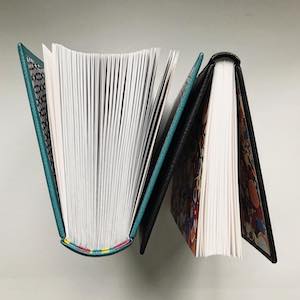
Leather bindings
Where do you look for inspiration when you are designing new products?
Out the window! My studio overlooks the Sound of Iona, across to our neighbouring islands of Mull and Erraid. I love the ever-changing colours of the water and landscape around here. They always find their way into my books, whether I intend them to or not.
I am fascinated by the history of bookbinding so I’ll also often look to the past when seeking structural inspiration. I love exploring books from other times and cultures –– like learning that books in Asian cultures often have the paper folded at the foredge rather than at the spine as is the norm here. Which may seem odd unless you also understand the materials they are using. If you think of Japanese kozo paper for instance, it’s strong as anything which makes it perfect for book repair and conservation. It’s less ideal if you are wanting to print double-sided. But if you fold it at the foredge then you can turn pages as you leaf through the book and have printing on both the recto and verso. And because the paper is so thin the book is still a reasonable weight and size, not overly bulky.
My current favourites are medieval bindings with wood boards which have sewing supports of cord or leather laced in. I’m currently working on a project in this vein that I’m quite excited by. And can’t wait to share it!
Can you tell us a bit more about how you make your products?
There is a huge variety in styles of bindings, so the process will vary by book and materials. But they all need to start with the design concept. Whether this is based entirely on what I want the end product to be (if I am making a book for sale or exhibit) or on discussions with my client as to their requirements and desires for the books (if it is a commission piece or a book repair), they all start with numerous notes and scribbles in my sketchbook.
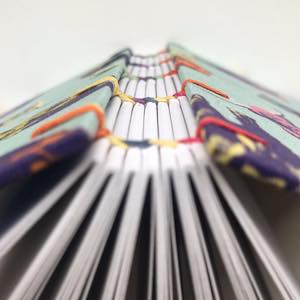
Baile mor bookbinding
Then there’s choosing materials. What paper will be used for the interior, and will it be printed or left blank? How and where will it be printed? What size does it need to be? And will the cover be leather, vellum, bookcloth, paper, or a combination? Does it require any special materials, such as hardware, alum tawed leather, or quarter sawn oak boards? All of these decisions are considered while taking into account the budget, the aesthetics, and the intended use and storage of the book. I use materials that are archival in nature to give the book the longest lifespan possible, unless it’s specifically meant to be ephemeral and have a shorter life. If the project is a repair then it’s also important to choose materials that are sympathetic to the original and will not cause any further harm.
Actually making the book can sometimes feel like quick or easy part of the process, even though that can take weeks, even months if it’s a full design binding. It will involve some combination of folding, collating, sewing, and construction of cover, alongside the design choices needed.
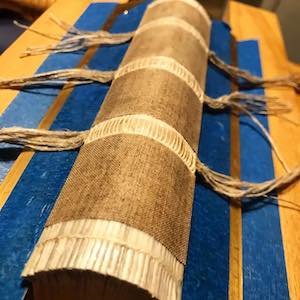
Process – rounded and backed
As an example, and very briefly, this would be the process for a quarter, half, or full leather binding:
- collate and fold the pages into sections
- make the endpapers and their accompanying sections
- sew the book on cords or tapes
- line the spine, round and back the book
- attach the cover boards
- sew the endbands
- shape the boards
- pare the leather for covering
- cover the book with leather and/or bookcloth and paper
- finish with any decoration such as gold or blind tooling or other leather decoration
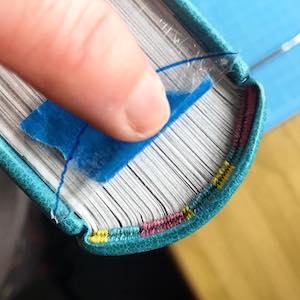
Headbands on leather binding
Design bindings and repairs will often also need a clamshell box or other protective enclosure. I make this at the end to ensure it fits the book perfectly. Even these can range from simple to intricate, depending on what they will be holding.
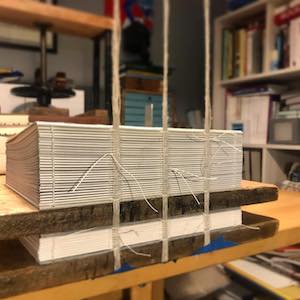
Process – sewing on cords
What are your most popular products and which are your own favourites?
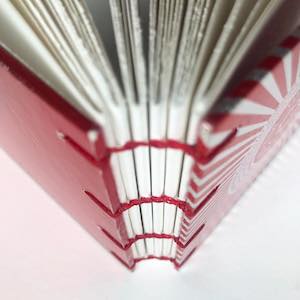
One of my most popular sellers are books that I started making more out of curiosity to see if I could, little Tunnock’s books. These are wee sketchbooks / notebooks with an exposed spine binding and a re-purposed Tunnock’s wrapper on the cover. I grew up in Canada and when I first moved to Scotland the Tunnock’s branding really stood out to me as such a unique cultural icon that I wanted to celebrate in some way. I sometimes have to outsource the eating of the Tunnock’s as I can’t keep up with the wrapper requirements. Fortunately many friends are more than willing to lend a hand.
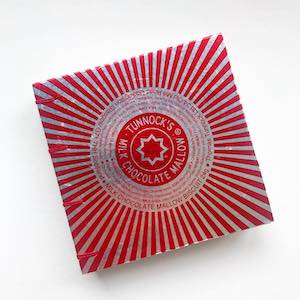
Tunnocks Book
I’m very fond of the Tunnock’s books, but if I had to choose a favourite it would not be one particular book but a category: full leather design bindings. These books are absolutely the most involved and demanding of any style of book I make. Each individual stage involves a new skill or technique (or three!). It’s hard not to grow fond of a book that you spend so much time with, focussing on each individual detail and aspect. Part of what I love about bookbinding is the combination of design and engineering and these books really combine both aspects. I also get to do things with these books that I really enjoy and rarely get to employ on others, like sewing headbands.
If you had to pick one place in Scotland to recommend that people visit, where would it be?
Iona, obviously! It’s a stunning little island and well worth the trek.
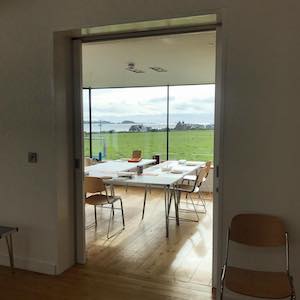
Baile Mor workshops on Iona
On a larger scale, I can’t recommend the Outer Hebrides highly enough. Particularly travelling along the spine of the archipelago and experiencing one island after another. Each one is unique to it’s neighbour and has something new to offer. My wife and I travelled tip to tail a few years ago and it was a fantastic way to spend 10 days. North Uist was a particular favourite and an island to which we will definitely return.
And few recommendations of other creative businesses, some that I’ve worked with before and some that I would like to or appreciate:
Iona Craft Shop https://www.
Oran Creative Crafts http://www.orancrafts.
Hackley Bags https://hackleybags.com/
Loom Graphics https://www.
Cally Booker https://callybooker.co.
Baile Mòr Books can be found on facebook , Twitter, Instagram and Pinterest!