How do you make Linen Yarn?

Linen has been cultivated from Flax for at least five Millennia. Linen weaving can be seen in the ancient egyptian paintings dating back to 3,000BC. In fact it was a finely spun line yarn cloth which was used to wrap mummies. It has been a cool and comfortable fabric to wear in the middle east and mentioned in the Bible.

While the Flax plant is relatively easy to grow, it is very labour intensive to process. Early American settlers were growing the Flax plant in the 17th century but by the 18th century, with industrialisation, it was much easier and cheaper to produce cotton.
To this day, Linen is mainly produced in Europe and North Africa with no commercial production in the US.
The Flax plant is an annual crop and grows to it’s full height within 90 days before it turns yellow and is ready to be pulled up. It must be pulled rather than cut so it will retain sap. The stalk is then retted, the woody outer layer is removed using chemicals or water. The stalks are then put through rollers to break off the shives or bark. The inner Flax fiber is then combed. The yarn is then put through a wheel frame and spun onto spools.
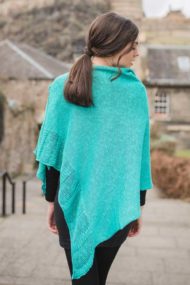
Linen is one of our favourite yarns to work with, it is a strong and structured yarn, with a beautiful texture. We use it in almost all out garments and recently it has been given the spotlight in our 100% Linen Capes.